
Do elephants use names to communicate?
Animals can communicate with other individuals to attract, alert, or dominate, which plays an important role in their lives. Communication between animals occurs when a sender organism does an action or signal perceived by a receiver organism, which likely would alter its behaviour pattern in an adaptive way to either one or both involved individuals.[1] Specifically, elephants have a highly developed communication system. Elephants are exceptionally social and cooperative animals, and distinct vocal, tactile, olfactory, gestural, and seismic signals influence their interactions.[2] Even though elephants have complex and sophisticated communication methods, we haven’t found evidence of a communication system similar to humans. However, a recent investigation suggests that African elephants (Loxodonta africana) might use individual-specific calls similar to the way we humans use personal names for calling each other.
Understanding elephant communication
Elephants are highly intelligent and exhibit a complex social system such as fission-fusion societies.[3] They have a high capacity for learning vocal sounds. They can distinguish between the vocal signatures of familiar and unfamiliar individuals.[4] They also have extraordinary social memory associated with their large brain (e.g., the largest among land mammals). Furthermore, they have the most scent-detecting-related genes.[5] Interestingly, elephants also have the ability to use their feet for communication. Using their flat feet (Figure 1), they can recognize seismic vibrations from the soil, which are carried up to their ears through the bones. Thanks to this sophisticated ability, elephants can sense low-frequency rumblings, stomps, and danger from up to approximately 32 km away. This gives them outstanding long-distance communication skills.[6]

The concept of “names” in the animal kingdom
We once believed that the concept of “giving names” was unique to humans. However, evidence suggests that it is not exclusive to Homo sapiens. Other social species, such as green-rumped parrotlets and bottlenose dolphins, use signature calls (e.g., similar to a name) for calling other individuals.[7] For instance, dolphins can learn the name (i.e., signature whistle) that their mother gives them. Also, similarly to elephants, dolphins can remember specific sounds associated with other individuals from the same social group.[8] However, the whistles from dolphins and parrolet calls are slightly different from what humans do. This is because our names (Figure 2) are more than unique noises, more abstract, and less tangible.[9]

Evidence of “naming” in elephants
A recent investigation suggesting that African elephants use individual vocal labelling in a similar way to humans was published in an unrefereed preprint (i.e., not certified by scientific peer review, edited, or typeset before being posted online) in August 2023.[10] A group of scientists from Colorado State University and experts from Kenya and Norway reported that “wild African elephants address one another with individually specific calls without any evidence of imitating the receiver’s vocalizations.” The relevance of these findings is that this system resembles more of that of humans. Moreover, Pardo et al. found that elephants responded differently to calls specific to them than calls directed to a different member. A reduced number of species has been documented as capable of addressing conspecifics with different vocal labels. However, this type of labelling has been found to be imitative or of unspecified structure. In this regard, Pardo et al.’s findings could be one of the first shreds of evidence showing a species other than humans “individually addressing conspecifics without imitating the receiver.”[11]
Elephant intelligence and social structure
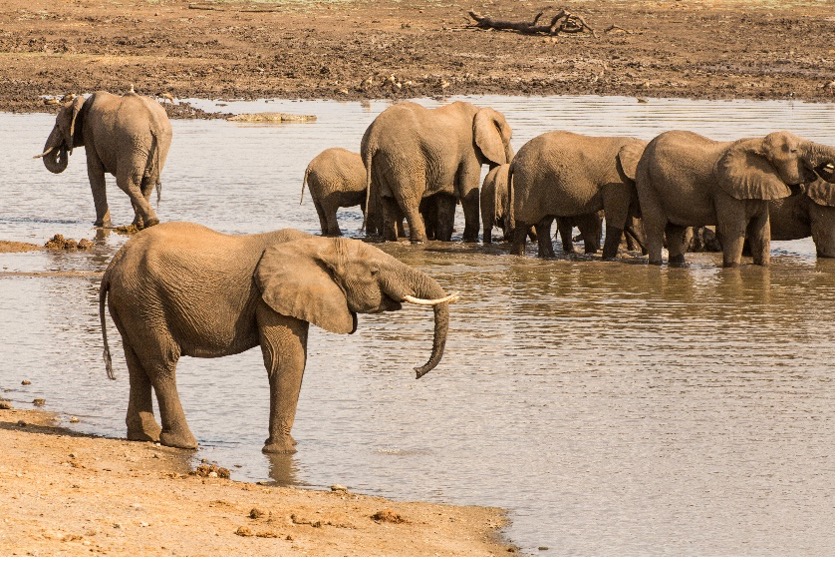
From those recent findings, we understand further the intelligence and social structure of elephants (Figure 3). For instance, individual vocal labelling could improve the coordinating capacity of elephants when they are out of sight of each other.[12] Also, it seems to strengthen the social bonds among specific individuals.[13] Individual vocal labelling is a highly valuable tool, particularly for exceptionally complex social animals with fission-fusion dynamics, such as elephants.[14]

Conclusion
As the current data indicates, elephants might not exactly be saying “You all know exactly who I am. Say my name” (as the infamous character from Breaking Bad, Walter White, said). However, elephants are sophisticated and complex animals. They can produce individual vocal labels which give them several evolutive advantages in their environment. Many more questions remain unanswered regarding the complexity of social cognition, symbolic communication, and social decision-making of elephants. The more knowledge and information we can gather from these magnificent animals, the more potential beneficial implications for conservation efforts.
[1] Erin Gillam, “An Introduction to Animal Communication | Learn Science at Scitable,” Nature Education, accessed October 4, 2023, https://www.nature.com/scitable/knowledge/library/an-introduction-to-animal-communication-23648715/.
[2] Robbie Ball et al., “Acknowledging the Relevance of Elephant Sensory Perception to Human–Elephant Conflict Mitigation,” Animals 12, no. 8 (January 2022): 1018, https://doi.org/10.3390/ani12081018.
[3] Daniela Hedwig, Joyce Poole, and Petter Granli, “Does Social Complexity Drive Vocal Complexity? Insights from the Two African Elephant Species,” Animals 11, no. 11 (November 2021): 3071, https://doi.org/10.3390/ani11113071.
[4] Noa Pinter-Wollman, Lynne A. Isbell, and Lynette A. Hart, “The Relationship between Social Behaviour and Habitat Familiarity in African Elephants (Loxodonta Africana),” Proceedings: Biological Sciences 276, no. 1659 (2009): 1009–14.
[5] Veronika C. Beeck et al., “Sound Visualization Demonstrates Velopharyngeal Coupling and Complex Spectral Variability in Asian Elephants,” Animals 12, no. 16 (January 2022): 2119, https://doi.org/10.3390/ani12162119.
[6] Beatrice Christofaro, “Amazing Planet: Elephants Communicate from Head to Toe,” Deutsche Welle (DW), August 9, 2022, https://www.dw.com/en/biodiversity-poaching-africa-asia-nature-wildlife/a-62564160.
[7] Helen Pilcher, “Do Animals Give Each Other Names?,” Science Focus, January 21, 2022, https://www.sciencefocus.com/science/do-animals-give-each-other-names.
[8] Pilcher.
[9] Carly Cassella, “Amazing Discovery Claims Elephants Have Specific ‘Names’ For Each Other,” ScienceAlert, September 8, 2023, https://www.sciencealert.com/amazing-discovery-claims-elephants-have-specific-names-for-each-other.
[10] Michael A. Pardo et al., “African Elephants Address One Another with Individually Specific Calls” (bioRxiv, August 27, 2023), https://doi.org/10.1101/2023.08.25.554872.
[11] Pardo et al.
[12] Pardo et al.
[13] Pardo et al.
[14] Elizabeth A. Archie and Patrick I. Chiyo, “Elephant Behaviour and Conservation: Social Relationships, the Effects of Poaching, and Genetic Tools for Management,” Molecular Ecology 21, no. 3 (February 2012): 765–78, https://doi.org/10.1111/j.1365-294X.2011.05237.x.