
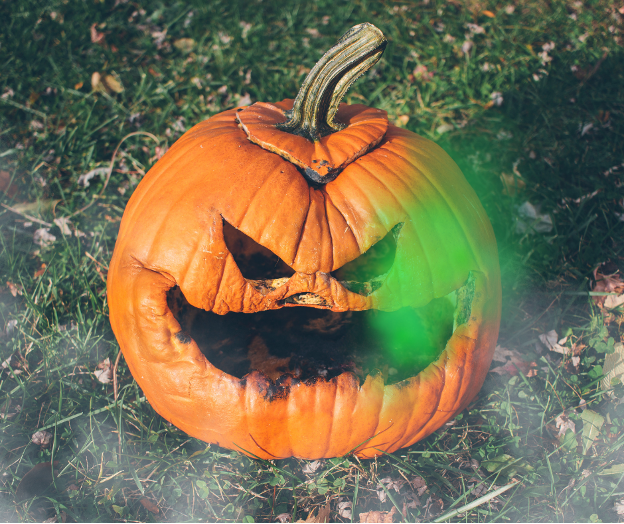
The carving of pumpkins into jack-o-lanterns has long been a creative and spooky Halloween tradition. But few understand how the mutilation of produce came to be a common October custom.
Carving pumpkins during Halloween is derived from an Irish myth recounting the story of a man known as Stingy Jack. Stingy Jack tricked the devil for monetary gain, died, was banished from heaven, and sent to hell for his greed. When Stingy Jack faced the devil in hell, the devil refused him entry and therefore sentenced to roam the Earth for an eternity in a tormented, purgatory state. In practice of this myth, the people of Ireland would carve demonic faces into the bodies of turnips and place them at their doorsteps at night to frighten away Stingy Jack and other wandering, tormented evil souls.
The tradition of Samhain is a Celtic festival held on November 1, where the veil between the gods and the human realm is thinned, allowing the gods to play tricks on mortal beings. The Irish diaspora brought this tradition to America, where pumpkins were used for carving instead of turnips due to their regional availability.
On our consumerist calendar, November 1 marks the end of the spooky season and the transition to winter. Stores once glutted with inflatable ghosts and witches, 8-foot-tall skeletons, and boxes of chocolates and candy corns are soon replaced by tinsel and holly, 8-foot-tall Evergreen trees, and boxes of sugar cookies and candy canes.
As people prepare for the rapid approach of the Christmas and holiday season, Halloween is kicked to the curb. And their once-cherished and carefully carved jack-o-lanterns follow suit. But the disposal of the decaying corpses of pumpkins during Halloween (a common Halloween decoration) is not the end of their reign of terror. They have an even more startling destiny ahead of them – a contributor to the climate crisis.
Decomposition of pumpkins
According to Statistics Canada, roughly 82,000 metric tonnes of pumpkins were produced in Canada in 2018. Most of these pumpkins are not used for food, but rather for carving Halloween jack-o-lanterns. Their rotting remains are sent to landfills shortly after. That is equivalent to the weight of roughly 40, 000 family-size sedans filling our landfills each year. The problem with rotting pumpkins during Halloween (and after) is not just the immense food and money wasted in this current economic period of struggle. It’s also the contribution that decomposing food waste in landfills has on global warming.
Pumpkins (which are technically considered a fruit from the Cucurbitaceae family) consist of skin, leaves, flowers, pulp, seeds, and a stem which are all edible. However, consumers of pumpkins rarely use any of these components of the pumpkin for eating, and most of these parts are forgotten, disposed of, and piled up in landfills after Halloween. The problem is that organic wastes cannot be broken down effectively in landfills.
Understanding landfills
Despite many perceptions, modern landfills are not just random heaps of rank, putrefied trash. They are facilities that are managed and engineered in a way that will protect the environment and comply with government safety guidelines. However, consumers need to be responsible for the way they dispose of waste.
Organic materials should not be sent to landfills but rather should be composted. When organic materials are sent to landfills, not only do they take up space for materials that should be there to properly decompose, but they also get buried under layers of waste. This deters them from decaying properly. This creates an anaerobic environment, an environment that does not allow for the free flow of oxygen. Such anaerobic environments will support the production of harmful greenhouse gases such as carbon dioxide and methane.
Pumpkin and methane
Methane is one of the most harmful greenhouse gases (a category of natural gases responsible for trapping heat in the atmosphere), second only to carbon dioxide. Although methane can be found naturally in our atmosphere, humans are largely responsible for methane concentrations in the atmosphere doubling within the last century. This is mainly due to our agricultural practices, production of natural gas for energy, and irresponsible use of landfills.
As reported by Jain et al. (2021), “Municipal solid waste (MSW) landfills are one of the major source categories that are required by US federal regulations to report annual greenhouse gas (GHG) emissions. In 2018, MSW landfills reported emitting 89 million metric tons of CO2 equivalents, accounting for 82% of the waste sector emissions and 17% of all methane emissions in the US.” Therefore, it is imperative that waste is properly disposed of before being sent to landfills to reduce the amount of methane emissions produced.
Another study conducted by Robert Czubaszek, sought to analyze the methane yield of apples, cabbages, pumpkin, and walnut husks when disposed of in landfills. Czubaszek tested the methane production peaks of these four decomposing fruits and vegetables over a 30-day experiment. He discovered that on the day 10, when all substances reached their maximum daily production of methane, the organism with the highest production of methane was pumpkin residue. That is 82,000 metric tonnes (roughly 10 million pumpkins) rotting in landfills and releasing methane into the atmosphere in Canada alone.
Solving the problem of pumpkins during Halloween
Halloween is a time of fun spooks, imaginative costumes, and creative carvings. Among all the fun of tricks and treats we experience, it is important to be reminded of the responsibility we hold. This is not to say that we cannot purchase pumpkins during Halloween or engage in the practice of carving jack-o-lanterns. But there are ways we can be more mindful consumers.
Instead of throwing away your pumpkin innards the day of carving, clean off the pumpkin pulp in the compost and roast the seeds for a delicious and fibrous pumpkin seed snack. Alternatively, blend your pumpkin into a hearty pumpkin soup. If you are not a fan of pumpkin flavour, have a fun time smashing your pumpkin into chunks and composting them. If cooking and smashing seem like too much work, simply donate your pumpkins to local farms that can use your leftover pumpkins responsibly. The horror of Halloween should be left to the imagination, not in the reality of the current climate crisis.