
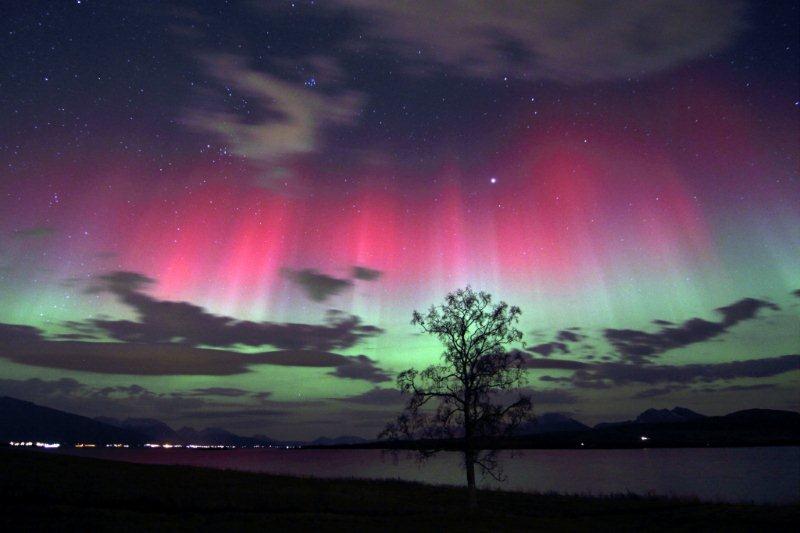
Imagine being outside in a snowy forest beneath a dark, clear sky. Then, all of a sudden, it opens up to shimmering curtains of green, purple, and pink. This fantastic astronomic display is the Northern Lights phenomenon or Aurora Borealis. Let’s delve deep into the equally fascinating solar events that cause it to understand more about the miraculous Aurora Borealis as well as its relationship with our climate and environment.
What are the Northern Lights?
The Northern Lights, or Aurora Borealis, are natural light displays, predominantly seen in high-latitude areas close to the Arctic and Antarctic regions. There appears to be no other set of balletic waves, with each hue emanating predominantly from the green light. It is also a dance intermixing with reds, yellows, blues, and violets in the sky. The term “Aurora” takes the name from the Roman goddess of dawn, and “Borealis” stands for North. On the other hand, the southern aurora is called Aurora Australis. Auroras are created when solar winds hit Earth’s magnetic field. Solar winds are colossal and rapid streams of electrically charged particles that emanate from the solar atmosphere. According to NASA, the auroras occur when charged particles from the sun collide with gasses in Earth’s atmosphere, causing them to emit light.
The science behind the spectacle
The Northern Lights is a phenomenon that results from an interplay between solar winds and the Earth’s magnetic field. The solar winds speed away from the sun with a velocity of about one million miles per hour and include such charged particles as electrons and protons. On reaching the Earth, its magnetic protective bubble, a magnetosphere, traps these particles. Induced by the interaction with the magnetosphere, these solar winds are streamlined toward the Polar regions. Here, the charged particles collide with atmospheric gasses, thus exciting them. Recombining to their normal state, these gasses give out energy in the form of light. These include green and red lights generated from oxygen, and blue and purple lights from nitrogen. The altitudes at which these occur also contribute; those having low-altitude meetings with oxygen generate green, while those with high-altitude meetings emit red.
Solar phenomena and their effects on the Aurora Borealis
Solar activity, especially sunspots and solar flares, contributes to aurora formation. Sunspots are small, dark spots formed on the Sun’s surface for relatively short times. These spots consist of very high magnetic activity. Compared with the surrounding area, these spots are more relaxed and generally emerge in pairs. More often than not, these spots also come with solar flares, which are sudden bursts of energy that release on the Sun’s surface. In doing so, large volumes of solar winds are transmitted.
Another prominent solar activity in this category is Coronal Mass Ejections (CMEs), where massive bursting of solar winds and magnetic fields blow out into, or even outward, from open space. When the CME is directed toward Earth, it initiates geomagnetic storms that strengthen auroral activity and make the lights observable at much lower latitudes than we are accustomed to. All these solar phenomena have a direct influence on Earth. The National Oceanic and Atmospheric Administration explains that solar flares and coronal mass ejections can significantly enhance auroral activity, making the lights visible at lower latitudes than usual. These same solar eruptions have the potential to wreak havoc on satellite communications, GPS systems, and power grids, demonstrating just how much more our star’s behavior affects our everyday lives.

Photo Credit: NASA, Earth Observations taken by Expedition 30 crewmember NASA ID: iss030e061267
Aurora Borealis and climate
The miraculous Aurora Borealis is not only an excellent natural light show, but it also enables us to unlock some secrets of how the sun’s activity influences the Earth’s climate. A study at the University of Southhampton suggests that increased solar activity can influence atmospheric circulation patterns, potentially affecting weather systems on Earth. This potentially provides an indirect driver of the weather patterns at lower altitudes on our planet. Some academics have proposed theories that go beyond these weather factors, such as the idea that solar activity affects weather systems or modifies phenomena like the jet stream.
In yet another step of circularity, auroras inform a type of understanding that assist scientists in space weather monitoring. The term “space weather” is sometimes defined to include all conditions and events on the sun, in the solar wind, and within Earth’s magnetosphere and ionosphere that have the potential to adversely affect the performance and reliability of space-borne and ground-based technological systems on Earth or in space. The observation of auroras enables better forecasts and adequate preparedness for such events to reduce the impact on communication systems, power grids, and even climate models.
Broader implications of Aurora Borealis research
Research is broader than just pure appreciation of the beauty and aesthetics involved with auroras, to issues of vast scientific and technological importance. For instance, scientists can understand the auroras, which will go a long way in enabling them to explain the general dynamics of space weather. This research is essential in devising technologies that are not only going to work with the different conditions of space weather, but are also immensely reliable in service for general function. On the other hand, aurora research contributes to knowledge about how the Earth’s atmosphere reacts to solar winds. It represents fundamental knowledge used in climate research and in predicting environmental change.
Auroras are natural laboratories that allow studying the phenomena of plasma physics, magnetism, and the behavior of charged particles in space. Among these, several breakthroughs of this nature have emerged from the research of thousands of researchers worldwide. Instruments used in data collection include ground-based observatories, satellites, and high-altitude balloons. Such studies not only increase our understanding of the auroras but also help in developing relevant technologies to enhance endurance and performance against space weather.

When and where to watch the Northern Lights
For those who can’t wait to witness the miraculous Aurora Borealis, here are the best times and locations to do so. The top locations are Norway, Canada, Iceland, and Alaska. All these areas fall within the auroral oval — a ring around the geomagnetic poles where auroras are most frequent. In these regions, lights are viewable quite often, especially during the winter months. One has a higher chance of seeing these glimmering marvels when the nights are longer, and the sky is dark.
These are best viewed when the sky is apparent and cloudless, with minimal light and pollution. They are also visible more frequently in March and September, close to the equinoxes, due to the tilt of Earth’s axis aligning better with the Sun. Use aurora forecasting tools such as websites and apps, which give real-time data about solar activity and probabilities for auroral displays. The Kp-index is a measure of geomagnetic activity, which means the higher it is, the more intense the auroral activity is, hence the better chances one has of seeing the lights.
In summation
The Northern Lights are a beautiful, complex phenomena that remind us how our planet works. These auras connect at the lowest level to the greater universe and its mysteries, from their captivating colors to the convoluted science that creates them. Understanding the scientific mechanisms that power the auroras and other solar phenomena heightens interest in space weather and its effects on Earth, climate, and technological systems. The auroras bid us all welcome, and they look to us as we do to them; to inquire about the disposition of the natural world around us.
So bundle up, get under a dark sky, and let the dance of the miraculous Aurora Borealis inspire your sense of awe and curiosity. The spectacle is so monumental that it indelibly touches the very fabric of those rare to see them. It shows the strength and beauty of nature, while also reminding us of our place within the cosmos and the continuous dance of solar and terrestrial forces.
2 thoughts on “Northern Lights: Unveiling the Mysteries”
Your blog is a constant source of inspiration for me. Your passion for your subject matter shines through in every post, and it’s clear that you genuinely care about making a positive impact on your readers.
Your blog is a constant source of inspiration for me. Your passion for your subject matter shines through in every post, and it’s clear that you genuinely care about making a positive impact on your readers.