
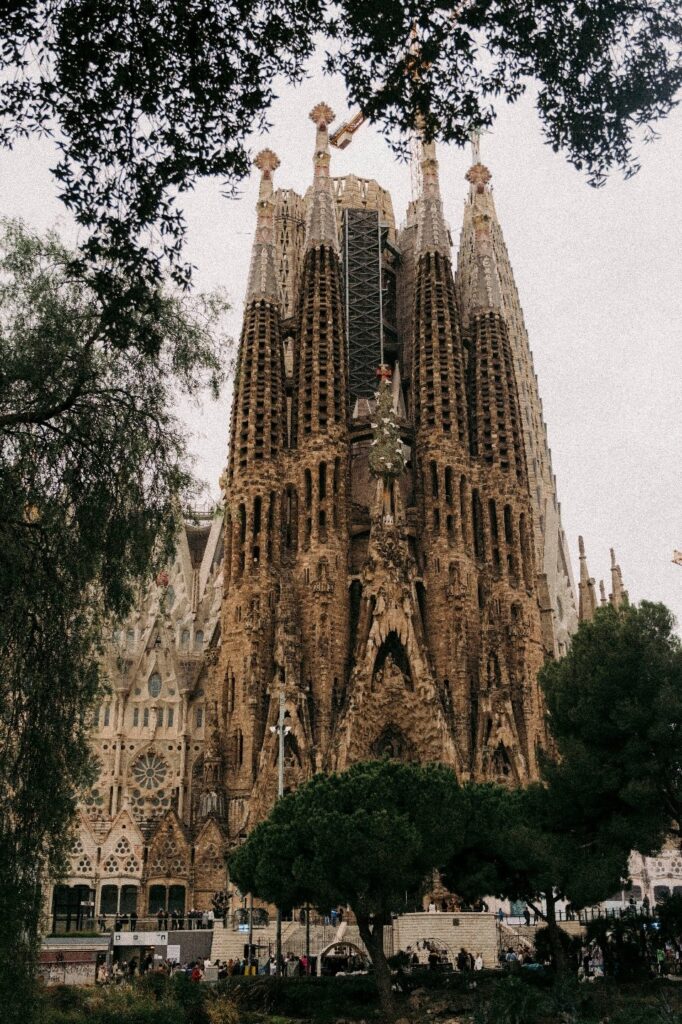
A lost giant in an alien land
If one were a bird flying over Catalonia, Spain, you would see rows of houses and buildings like little misshapen cubes trying to accommodate something that keeps pushing at its seams. Go a little lower and you will see the crowds engaged in mundane but necessary activities. Many are travelling, and some are resting, but all are headed to a place of their own. And then, you see an alien structure with its spires pointed upwards. Instead of having square windows, it has grand patterns and creases and is richly decorated on every inch of its body. You understand this curious structure must be a church, yet it becomes apparent that it refuses to fit into its environment. This is the “La Sagrada Familia,” a church that embodies various styles of historical architecture, designed by the Catalan Architect ‘Antoni’ Gaudi.
The basilica has been under construction for over 100 years and continues to this day. One wonders what it’s doing out here like an abandoned ship. This monument is incomprehensible because it seems to serve no purpose to the exercise of modern life and yet no one can resist being drawn to its exuberantly theatrical appearance. Gaudi’s vision speaks captivating language, but it’s opaque expression can be confusing for the modern mind.
Construction began in 1882 for a church in a standard Gothic form, but Gaudi took over in 1883. Gaudi took inspiration from the Gothic style but felt it was imperfect. The church embodies various styles of historical architecture, namely “Spanish Late Gothic,” and “Art Nouveau.” A surprising intertwining of two different and almost contradictory historical concepts and styles, the former, coming from the Middle Ages, is seen as imposing with its spires and pointed arches, whereas the latter chooses more organic shapes and curves that imitate the sensuality of the natural world.
Gaudi knew he wouldn’t see the cathedral’s completion. It was slowly being built through the private donations of the Catalan people. He himself spent the last phase of his life devoted to its construction and slept in his studio. One man sought to build eighteen spires, three facades that tell an ancient story in vivid detail with the characters and setting protruding from the structure, and then sought to make the interior of the temple a forest of stone. Two out of the three facades are complete, eight out of the eighteen spires are complete. The last façade is the most magnificent out of three, and when the spires are complete, it will make the Sagrada Familia the largest church in the entire world. These aren’t arbitrary choices made by Gaudi.
The spires, the facades, and the interior of the church are adorned with religious symbolism, making that strange but beautiful language not only comprehensible to our minds but also allows us to participate in the divine theatre of historical architecture, a historic monument.
Unraveling the story of the Familia’s symbols
The eighteen spires represent the main “characters,” so to speak, of the Christian story: the twelve apostles, the four evangelists (the gospel writers that tell us about the life of Jesus), the Virgin Mary, and Jesus Christ. There is a hierarchy here as well; the twelve spires of the apostles increase in height, the next tallest is the Virgin Mary, then the four evangelists, and the tallest is the one representing Jesus Christ. The facades represent the three main events of Jesus’ life: the Nativity, the Crucifixion, and his Resurrection.
The Nativity façade is the one Gaudi personally worked on. Symbols from nature abound, like the tortoise and the chameleon, which symbolize change. There are vines around the various characters, and green foliage on the door. As your eyes are moving from left to right, there are three porticos: the first representing Hope, which is associated with Joseph, the father of Jesus, the middle, which represents Charity, associated with Jesus, and the third, Faith, representing Mary.
As your eyes move upwards, you see an arch containing Mary and Joseph looking down on a baby Jesus. The segment containing St. Joseph has him questioning the families flight into Egypt, the opposing image portrays the slaughtering of the infants, showing him that if they stayed it would have cost the babies’ life; a thought-provoking image.
Interestingly, on top of these portrayals, is the arch that contains “The tree of life,” which in the garden of Eden symbolized man’s relationship with God. So, whoever ate from the tree was participating in this relationship with the divine. According to Catholic belief, the “Eucharist,” which symbolizes communion relates to the tree of life, and so, whoever participates in communion, participates in the tree of life. Gaudi wanted this façade to be painted so that the features would seem lifelike. This is the most enchanting of the facades as it symbolizes the joy of creation of when Jesus is born.

The second façade representing the Crucifixion, besides the incredible beauty and craftsmanship, is marked by controversy for two reasons: Gaudi wanted the portrayal to offend the aesthetic canons of what we find pleasant and charming. The tragedy of Christ’s crucifixion is to be shown in morbid details, all ornamentation is oriented towards the grotesque and bloody affair of the son of God being hung on a cross by his captors.
There are three pole-like structures that seem to be supporting the arch depicting the crucifixion that are meant to imitate the tendons of a man being stretched, and one is supposed to imagine the pain this might cause to someone who is hanging on a cross. However, if you look closely at the figures inside the arch, you will notice that the sculpted style of the figures differs from the Nativity scene. This is the second point of controversy; not only did Gaudi pass away before the second façade was being constructed but people are divided on whether the figures in their current form stay true to Gaudi’s vision. Instead of the figures having natural forms, they have sharp and angular features that are more akin to an illustration. Jesus is completely naked, and it lacks elements that invoke dread and trepidation to viewers.
Jose Subirachs was the man behind the second façade, his stylistic choices have been lauded by some and considered distasteful by others. Jose says he did what he thought was acceptable to the modern and secular culture of Spain and Catalonia. This widens the cleavage of cultural differences that was implied earlier; the historical architecture of the church is beautiful but out of date. Its ancient manners and customs are at loggerheads with the cultural novelties of modern institutions that don’t ground themselves on religious ideas.
This brings us to the glory façade. A representation of Christ’s resurrection, the final judgement, and the road to God, which remains to be completed but is supposed to be the grandest out of the three facades that cover the exterior of the church. If this wasn’t intoxicating enough for the eye, to reach the glory façade, one had to take a staircase that went through an underground passage representing Hell, Purgatory, demons, vices, and every other malevolent spirit that comes from the underworld.
To give adequate room to enter the church, Gaudi wanted a flight of stairs to stretch over a street, so that traffic can pass under it, and people could take the stairs to the entrance of the church. However, despite protestations from the people overlooking the church’s construction, a block of houses was built where the stairs were meant to be. It may seem as though indifference to the religious significance of the church may ruin the dream of Antoni Gaudi.
Exploring the spiritual tapestry
Facing an uncertain future, the precarious future of the temple may be disconcerting to anyone who seeks the welfare of its existence. But even if the modern mind is incompatible with the dense religious symbolism and allegory of Gaudi, the interior of the church once again brings the spirit of nature to turn the historical architecture church into a haven for souls, both in and outside of the Christian faith. The rising columns branch out, so they create an illusion of standing under palm trees, where light and shadows dance amidst the bark and foliage like that of walking through a forest. The altar is covered with grapevines and the gates are in the shape of a honeycomb.
Gaudi, inspired by the structure found in some plant species like the “oleander” and the “abelia,” where they rise to the sun in a helicoidal fashion, both down and upwards to symbolize the rising of the saints, and the descending of the angels.
The light from the top is a monochromatic stillness, but the stained glass windows is a polychromatic drama of red, blue, green, and yellow hues which imbues the interior with a mood for contemplation and prayer like one that sits down to study under the orange glow of a lamp. This is more familiar to our proclivities where beautiful architecture is a medium for contemplation and study. But these too are loaded with religious motifs. The colours pouring in from the windows are placed on the back of the facades. The yellow, blue, and green represent the birth of Jesus; and as one might imagine, the red and orange represent the passion façade and the resurrection.
The golden mosaic dome represents Christianity as a whole. The four main columns at the centre of the church have symbols on them representing the four evangelists: a winged man for Matthew, a winged lion for Mark, a winged ox for Luke, and an eagle for John.

There is discreet honesty in admitting words do not do justice to this magnificent temple. History, historical architecture, and religion intersect to create a divine theatre embedded in stone and glass. Gazing upon the church gives a notion of excellence, but brings with it the ambiguous joy of excess in the form of an economical question: “Do we really need such a grand thing taking up space to express our personal spiritual ideas when housing has become an international crisis?”
The Sagrada Familia was an expression of Gaudi’s spirituality and most places of worship we see have used symbols to convey a set of beliefs. However, one may note that images and art are not necessary components of spiritual belief and intense religious symbolism can seem ostentatious; ornamentation on and inside of historical buildings have no function besides lifting it’s aesthetic value and marking its identity. However, this is where our notions about symbols fail to comprehend art as a medium for religious experience.
Until now, we have seen what Gaudi’s religious symbols were meant to portray, but to unravel the mystery of why religious symbolism is used at all, we need to jump back into the eyes of the ancient faith Gaudi belongs to. According to the Catholics, the “Liturgy,” which is the form of worship, does not use art as an ornament, but creates a reality in which all what is being represented enters our reality.
Gaudi’s temple creates a mystical reality
To wrap our heads around this concept, I am going to borrow some ideas from Joseph Cardinal Ratzinger, the former pope, Benedict XIV, who happened to also consecrate the Sagrada Familia in 2010. Ratzinger says, in early Judaism, synagogues were richly decorated from scenes from the bible, they were not merely a representation of past events but were a narrative in which God’s involvement in Jewish history becomes present.
Since Christianity arose from Judaism, this tradition is carried forward and incorporated into the expressions found in Christian belief and history. Thus, the nativity, the crucifixion, and the resurrection, the key events of Jesus’ life are not only made present but transcend time in which past, present, and the future come together. A person who looks at this grand historical architecture is not merely looking at a representation but an entrance of the timeless divine into the temporality of human existence. Gaudi, being a Christian, may have thought that by employing his art to make the church he was participating in the narrative of the Christian story.

If this is the case, Gaudi was not merely trying to build a church, but the purpose of every ornament inside and outside of his tribute taps into a spiritual reality. His nativity scene is not akin to a picture of an event that happened over two thousand years ago but allows one to be a spectator among many who witnessed the birth of Jesus. So, in a sense there is no discontinuity between the past and present, but the artwork of stone makes one a witness to the event that has shaped history. Ratzinger also says, “he beholds in the sensible that which, though above the sensible, has entered into the sphere of the senses.”
Gaudi, with his unique placing of symbols of nature within the confines of the church, has enabled the viewer to contemplate the beauty of nature by sacralizing it. Nature is no longer the environment, a medium among many, but is a fountain of mysticism by giving it religious significance. Ratzinger notes, even the stained-glass windows perform the function of acting as an image by keeping out the obtrusive monochromatic light from the outside, and instead concentrating it through various colours in conveying the narrative of the Christian story. This connects the colours of the stained-glass windows in the Familia to portray Jesus’ birth, creation, the crucifixion, and his resurrection. The experience of Gaudi’s historical architecture through sight deepens all our senses and transforms them into a mystical experience.
A testament to historical architecture
The Sagrada Familia is one of a kind by combining the sensual and organic shapes of Art Nouveau with the imposing and sharp arches of Gothic architecture. Images of nature are twined with representations of the Christian story. Its exquisite beauty is alone to strike the imagination and transport it elsewhere.
However, this fusion may not appease the conscience of modern Spain and Catalonia, where art is great but its association with religion and historical architecture have become something of the past and the finishing of the Gaudi’s project may be halted and abandoned completely; destined to be another relic of the past.
And who can blame them? People evolve with the ages and, working tirelessly for a past people, no longer identify with what could sometimes be indicative of a lack of interest in growth and pushing the boundaries of human existence. It is often the case that we leave something behind to gain something better. But this does not deserve a dichotomy of past and present, many things can be left behind but what is eternal is always present: art is a great purifier of the human soul when it falls into despair and transfigures us when we achieve something great.
The art of religious symbols seems to be about the art of what lies beyond the periphery of vision, and instead through images, sublimates the human experience to overcome the impossible and expand our imagination. If that is what the Familia holds, then its value cannot be compromised. For beauty that makes human life worthwhile begins and ends in wonder.

1 thought on “Decoding Gaudí’s Sagrada Familia: Symbols and Artistic Narratives”
Andrew Paul, well spoken, well written! For Love of Writers, outstanding!
Ultimately, I would hope to see Iglesia de La Sagrada Familia used as an “Object Lesson” for what the Divine desires to accomplish in each one of us, the perfection of human character.
“Be ye perfect, even as your Father in Heaven is perfect.”
—- Jesus of Nazareth