
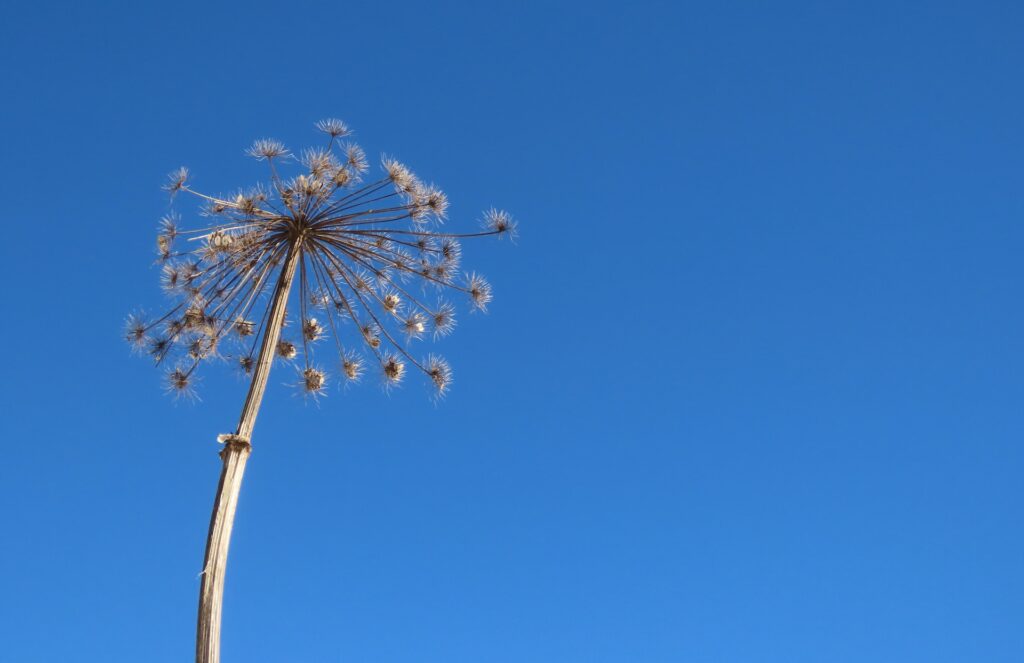
“Sweet flowers are slow and weeds make haste” – William Shakespeare
Weeds. You either like them or you don’t.
Unarguably, some weeds are a beauty to behold. Who would cringe upon seeing a field of yellow dandelions or a flowering swamp of milkweed? It all depends on your perspective – how one defines beauty. As endearing as some weeds are, many are toxic, such as belladonna, bittersweet nightshade, pokeweed, poison oak and, yes, hogweed.
The giant hogweed has generated some media attention, although it has been in the Maritimes since the early 1900s. The Nature Conservancy of Canada says that “Giant hogweed is one of Canada’s more dangerous plants.” If one has exposed skin that comes in contact with hogweed, it can cause blistering, burns, and scarring.
The history of the giant hogweed
The giant hogweed (heracleum mantezzagiana) made its first record of appearance in Nova Scotia in 1980, on the former estate of Alexander Graham Bell in Baddeck, Cape Breton. Bell may have planted hogweed in his garden a century ago. No one could blame him. It was viewed as an ornamental plant quite distinctive with white flowers similar to Queen Anne’s Lace, which is part of the same family. The main differentiator is that giant hogweed can grow up to six meters tall and spreads quickly.
Giant hogweed originated in the Caucasus area of Russia and Central Asia, being brought from Asia to Europe. It seems that people liked the appearance of hogweed, especially avid gardeners. They weren’t aware of the plant’s detrimental effects, particularly the sap. The handling of its seeds would not have posed a problem, given that the toxic sap is not in the seeds but rather in the stem and leaves.
It is possible that hogweed came to Canada inadvertently. Ships from Europe arrived here empty because they were bringing over heavy timber. To keep the ship upright, rocks and soil found near wharves and home ports were put in the hull. Once the ship was filled with timber, the rocks and soil were deposited on the visiting shoreline. Hogweed started appearing from west to east, possibly because rail systems were carrying such items as grain and livestock.

Why is it one of Canada’s most dangerous plants?
A large invasive plant, a giant hogweed’s sap contains furanocoumarins, a class of organic toxic chemical compounds that many plants produce. Skin exposure and exposure to UV radiation causes burning, itching blisters, and eventually purplish scars. The reaction can last for months with accompanying skin sensitivity to UV light for years.
Temporary or permanent blindness could be a possible result if the sap comes in contact with the cornea. Yet, much is dependent on human sensitivity, therefore reactions will vary between individuals. Some people have no reaction.
What does a giant hogweed look like?
A giant hogweed in its early stages is unrecognizable. It would be unusual, especially in an urban setting, once the leaves are out. Flowering of the plant takes up to four years and resembles not only Queen Anne’s Lace but Cow Parsnip and Angelica. The plant may have purple spots on a hollow stem. The small white flowers bloom in June and July and are clustered in a large umbrella shape and the seeds are oval shaped and flat.
The green leaves have stiff, stubby hairs on the underside and can be 2.5 metres in diameter. Hogweed will most likely be found by roadsides, places where fill has been deposited, gravel pits, and stream banks.
You should stay away from a giant hogweed once identified and know that it is making its appearance in areas where it wasn’t before. Once identified, this plant should be removed by a landscaping company.
If you feel that you have been exposed to this plant, wash the affected area immediately, avoid direct sunlight exposure, and seek medical advice, or call 911 in extreme cases.
Gardening is a pure experience in the interaction with nature and all that it beholds to satisfy and revel in its beauty. Perhaps Minnie Aumonier summed it up best, “When the world wearies and society fails to satisfy, there is always the garden.”