
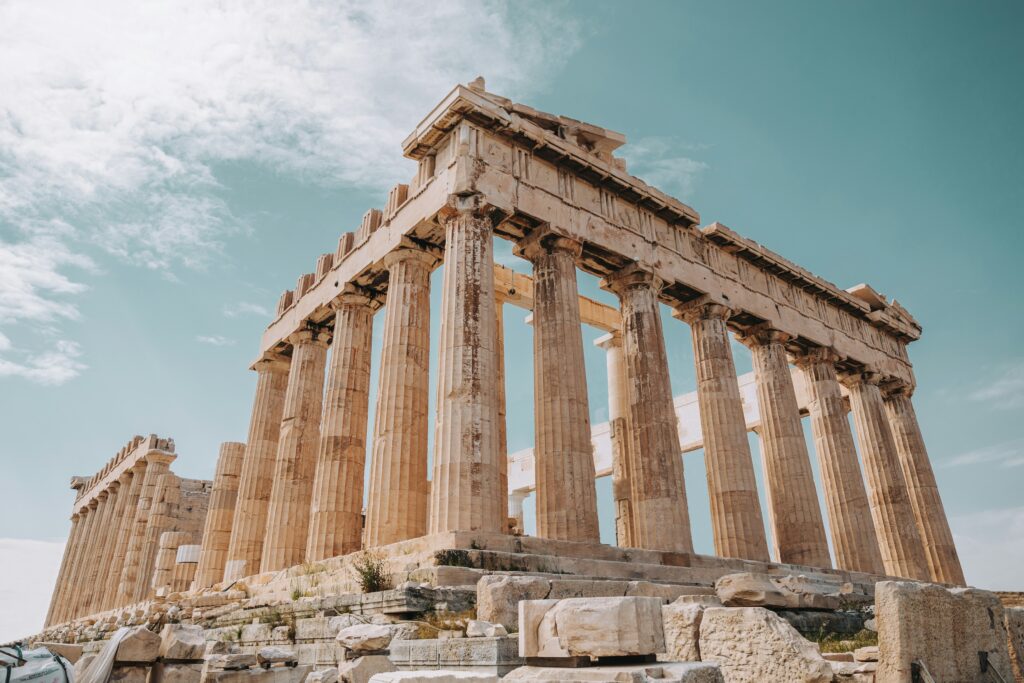
Many people believe that we should let go of the past, and perhaps that’s the right thing to do in terms of self-development. It can be unnecessary baggage for someone who is looking to go beyond their current situation. And yet, history remains a valuable resource for us to draw lessons from. Oftentimes, we forget to recognize that we are also ancient beings. The modern world is different from the ancient world. It is a fascinating affair to curiously uncover why things are so different in modern-day society when the people who exist now are no different from the people who lived back then. So, let’s delve into ancient Greek art and bring back a souvenir that might help us see the present-day world in a different light.
These lessons are lost in the vast volumes of historical events like how old photos get lost in our gallery. Niccolo Machiavelli, the famous Florentine diplomat and author, once implied that the passions that animate us, animated the ancients as well.
Ancient Greek Art
This memory comes from Ancient Greece: the life and blood of Western civilization. The Greeks’ contributions to the fields of philosophy, arts, and politics, have shaped various aspects of modern society, whether we acknowledge it or not. The Greeks had a peculiar fascination with beauty and its connection with nature. In a way, seeing the beauty in everything made life more meaningful.
When we think of beauty, we associate it with pretty things – beautiful faces, scenery, food, jewelry, etc. Meanwhile, when we think of nature, we associate it with the earth. There is no link between the two, to us at least. We consider beauty and nature to be separate categories, or perhaps, we never seem to recognize that a beautiful face is also part of nature and only notice the features.
For the ancient Greeks, nature had a viscerally hypnotic effect on their minds. It was a force of vitality that colored their religion and customs. For example, they would see a beautiful person or something like a waterfall and perceive it as a symbol of divinity. In their imagination, red would become the deepest of red, a galloping horse would be portrayed with cinematic quality, and the face of a beautiful person would become the inspiration for the face of a god or a goddess. Nature was the source, but the mind gave nature what it was lacking. And so, a sculpture would not simply depict a man, but accentuate his features to appear more ‘god-like’. In every aspect of life, whether sports or a person’s character, beauty was the primary focus.

To explain this in detail, let’s look at Johann Joachim Winckelmann, one of the first historians to study ancient Greek art. He was a ‘Hellenist’, meaning he fully believed in Greek ideals as if he were a Greek himself. In his writings, you will find him scolding modern art because, to him, they tend towards realism rather than beauty. But his bias and romanticization of ancient Greek art throws light on what is exceptional about the ancient attitude, as opposed to the accumulation of dry facts of the distant past. Winckelmann draws attention to the Greek fascination of beautiful bodies – the formidable muscles and contours that shape the human body. Winckelmann also emphasizes the simplicity of Greek outfits, a sentiment that Plato echoes, as he considered ornate fashion to hide a body that lacks admirable contours and features.
Spartan youth showed themselves naked before judges, so they could evaluate the young men’s bodies and reproof them if they found imperfections. The men practiced in the gymnasium naked, and sports went beyond competition and pride, but also became the chance to seem god-like in the dexterity of their bodies. In some solemnities, women would dance before the men unclothed, and on other occasions, women would go bathing in a pond, and rise from the waters before unsuspecting spectators, only to become a model for a statue of Aphrodite.
Winckelmann goes on to articulate this peculiar fascination with perfecting the human body by talking about beauty contests. Another important realization is that not only did the Greeks glorify and admire something as simple as the body, but also sought to improve it through idealization. It didn’t matter if what nature had already provided was perfect; there was always a way to turn the ordinary into the extraordinary. Therefore, Winckelmann not only drew attention to how ancient Greek art sought to imitate natural bodies but also to how the Greeks idealized them.
Skin that presses into the muscle too much was made to appear softer so that there was harmony in its appearance. This was done to downplay any ‘imperfections’ and instead curate an appearance devoid of flaws, closely resembling a sense of ‘divinity’, or beyond the nuances of reality. Such an idea is present even in the 14th-century Renaissance, where artists took natural forms but gave them an ethereal dimension.

Living Is Also an Art
The theme of Greek art is quite fascinating, but without becoming an essayist on art history, what can we infer from the facts we have learned? What does this mean to us? Are we to become artists focused on the natural beauty of our world? The inference can be quite strange: whatever you need to make worthwhile, already exists, and is with you right now. There is a tendency to think that once things get better in our lives, or if we have something that we don’t have now, everything will become better. For example, we may have persistent dreams about a particular career or grow frustrated about not living in the area we want, yet all this does is focus on a problem rather than a potential solution.
While concentrating on the issue is something for the future, acting on the solution necessitates our actions in the present. Perhaps, this is because we live in a technologically advanced age that complicates every aspect of our lives. Marco Pierre White, a world-renowned chef said that young artists overwork their material by bringing in too much information and skill and feel like they have to use it all. Instead, mother nature is a true artist and what makes a great chef is that they keep it simple.
Given our present-day environment, technology barricades our minds from perceiving natural circumstances as something to improve and work on. In my own life, I would rather seek some titillation from scrolling on my phone, rather than working on something I could be proud of. But this isn’t because I’m lazy. It’s to avoid the patience it takes to create something.
Perhaps, we often think about the future and wonder where we will be in a few years. The uncertainty haunts us, and this is because the elements that create uncertainty are incalculable. These factors make everything more complex than what our minds can handle. However, the ancient Greeks, unfettered by modern obfuscations, appreciated the present in its fullness. The ancient Greeks focused all their abilities on how to make the best of what they already had.
Nature is complex, but to experience it, all we need to do is be present in the moment and be open to whatever experiences it has to offer. This doesn’t take much intelligence or a methodical approach. For example, the smell of a garden, or the beauty of a sunset are simple things. However, the effect these experiences have on the five senses is beyond simple. These experiences are the subjects of art and poetry and produce uncompromising feelings that make up a whole memory. Perhaps, that is something we can learn from our ancient predecessors.

Whatever You Need is Already With You
Take a moment to look around you, and have some gratitude for where you are. Realize that when negative or unpleasant thoughts consume you, ruining the present, as well as the future. The subtle, yet notorious habit of abandoning the current state of life because of dissatisfaction, can only be more corrosive to your well-being. A relentless inquisitiveness to our daily situation with scrambling thoughts like, “Will I get along with them?”, “Does it matter?”, “There is no point in this”, and “This could lead to a disaster”, are all indicative of a controlling and unstable mindset. Instead, we should learn how to manage our emotions and focus on responding to any situation with a calm mind.
Negative emotions like hate, elevate mental pressure and other stresses. Saying “I hate this so much” and getting caught up in the feeling becomes a substitute for action. But the mere notion is insufficient to lift someone out of a bad situation or to make it better.
No matter how difficult the circumstances, you don’t become yourself by thinking about it; rather, you become yourself by interacting with the world around you. It is easy to play around with the endless possibilities in your mind, but to actualize a possibility requires us to embrace the discomfort of interacting with the world to get what we desire. Most of the time, we have the option to quit the situation we are in, from being in the wrong place to getting up in the morning, if things get difficult or boring, we simply pull our phones out, and this leads to unnecessary complexity because we start indulging in fantasies that are not aiding our growth. This habit of withdrawing from a place due to a slight displeasure of things not going our way extends to friendships, family bonds, and romantic relationships as well.
How many times have you noticed people expecting but never giving? This happens because we think we are above the situation, but we are as much a part of it as the world is a part of us.

A Radical Acceptance of Both Tragedy and Beauty
For the ancient Greeks, the simplicity of being surrounded by the vital forces of nature was a reminder that where they belonged was right there in front of them. An acceptance that made their endeavors keener and more purposeful when all their energy went to strengthening their relationship with nature to the best sensuous experiences. We find this in their philosophy, arts, and poetry.
We see the world in a single moment. So, then nature is the material we must work with, but also a mother where all beauty waits for the right hands to awaken it. Caterpillars die and then turn into butterflies, a metaphor for a human being’s metamorphosis. It becomes a liquid, utterly devoid of its previous form. So profound, yet simple enough for our minds to be bombarded with information to overlook. This brings us to another unexplored idea, partially because it is uncomfortable to accept.
What I have said up until now may jibe well with many. However, the caterpillar must die to become a beautiful butterfly. Can we also accept that death and its emissaries are woven into the fabric of nature? The idea of death gives rise to the possibility of achieving greatness. We can fully appreciate the present because we know it could end at any moment. I do not have to explain that nature gives us tragedies and sorrows that can sometimes make life unbearable and shatter any meaning.
Our endeavors become a way to escape the chaos we are born into. We commit to people and jobs we don’t like, so that we can survive and hopefully remain ourselves at the end of the day, while always searching for something more profound and fulfilling. Through all of this, we go on, like the Austrian poet, Rainer Maria Rilke said, ‘Just keep going, no feeling is final’. We can always rest in the fact that whatever we are going through is passing and there is a new opportunity to make things better just around the corner.
Live Like an Ancient Greek
Accepting the uncanny side of nature goes against the grain of human intuition today since most human ingenuity has been to overcome the deadly unpredictability of nature. What can our ancient predecessors teach us in this regard? Did they just concoct and engage in tasks to maximize their pleasure and minimize their pain? A remedy to ease the pain of being a helpless subject of an ultimately indifferent world?
Frederich Nietzsche, another Hellenist, popularly known as one of the primary forebears of existentialist philosophy, had much to say on how the Greeks saw tragic phenomena as an aesthetic experience, thus enriching life experiences. In his work, ‘Homer’s Contest’, Nietzsche draws attention to how Greek myth draws itself out of murder and the atonement of murder; life is a contest against the cruelty which the world imposes on us. In one myth, the goddess ‘Eris’, pushes people into strife and discord, and ‘Envy’ leads to struggles, ultimately resulting in death.
What Nietzsche draws attention to, is that these deities are still good, not because they cause strife, but because they cause drama within the contest. There is an appreciation for the act of suffering itself for a greater goal. There is only an aesthetic criterion as opposed to a moral evaluation. Instead of trying to escape the suffering, why don’t we try to overcome it by not seeing it as an obstacle, but as the privilege to overcome an obstacle?

If you are in a state of life where things are not going the way you had envisioned, it is okay to feel hate or wish for a better life. However, we must remember to foster positive thoughts and stay hopeful. Otherwise, you could sink yourself into bad habits, which are nothing but temporary ways to escape your problems. Lastly, keep it simple like the ancient Greek.
Nietzsche points out that back in the day of the ancient Greeks, one could fight for one’s honor by entering politics for their city or honor it by excelling in a sport, music, or even war. There was a way to put all their focus into perfecting their chosen art for a greater goal. Nothing is as simple as picking up a craft, whether becoming an engineer or an artist for the sake of happiness. Instead, there are so many ways to feel fulfilled. Don’t try to calculate the best possible route in your head, but try everything, and even though it may be hard, eventually you will find what works for you and the pain will always teach you better lessons than regret does. So, whatever you do, love it, and never look back.
1 thought on “Lessons From Ancient Civilizations – Ancient Greece ”
My brother recommended I might like this web site He was totally right This post actually made my day You cannt imagine just how much time I had spent for this information Thanks.