
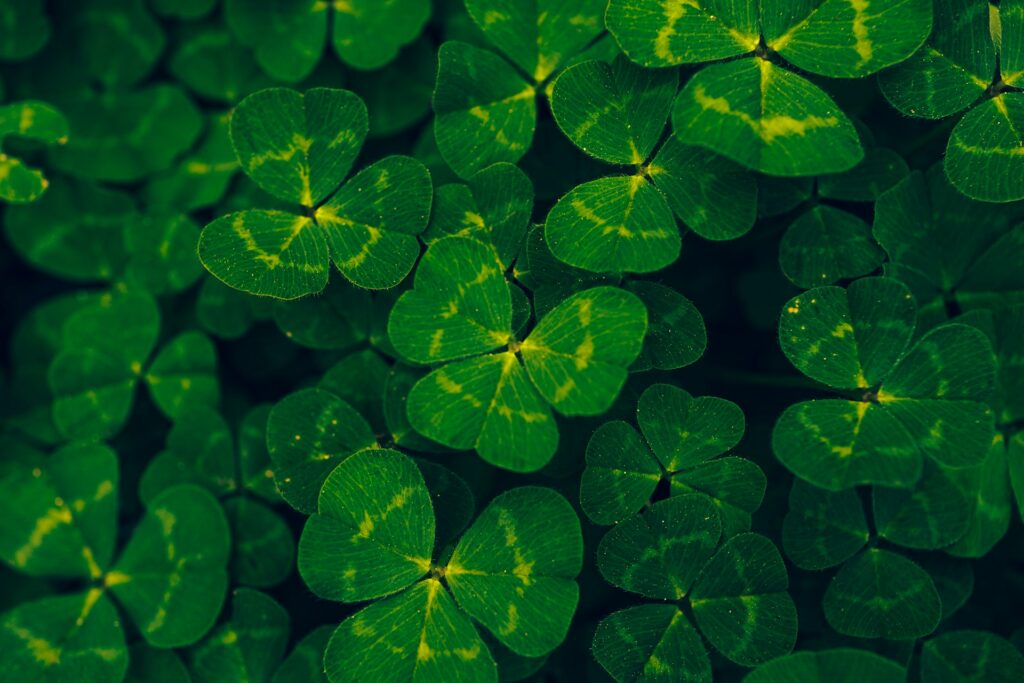
Green is symbolic of nature, the rebirth of spring and good fortune. The colour has long been associated with the Emerald Isle—Ireland—and its patron saint, St. Patrick, a Christian missionary and bishop during the 5th century. His birth name was Maewyn Succats and he was born in Kilpatrick, Scotland in 386 A.D. He arrived in Ireland in 432 A.D and died on March 17th 461 A.D.
A date to be commemorated
March 17th is commemorated and warrants the “wearing of the green” with shamrocks, green hats, hair, and beer. With its long history, the shamrock dominates the representation of this day but not without its misconceptions.
The true Irish shamrock or seamrog (little St. Patrick’s Day clover) can be one of four common clovers or trefoils, such as white and red clover, lesser trefoil, and black medick. The belief that shamrocks will not grow anywhere else but Ireland is not true. It grows in other countries as well.
Shamrock’s connection to Druids and Irish Celts
With its three heart shaped leaves, the shamrock was revered by ancient Druids and Irish Celts. They believed the shamrock could avert evil spirits because the number three was sacred and had mystical powers. As well, the ancient Iranians knew the shamrock as “shamrakh” and honoured it as a symbol of the sacred 3’s.
An Irish legend suggests that St. Patrick is credited with using the shamrock as a parable of the Holy Trinity (three persons in one God) and teaching Christianity during his life. Christianity did not exist before his arrival. His parable, according to folklore, secured the approval of Druid high priests, many of which converted to Christianity.
Some would argue that the saint neither had a real connection to the shamrock nor used it as an example since there is no concrete documentation to prove such. In fact, it wasn’t until 1571 that the word “shamrock” was found in written English. Nonetheless, St. Patrick still holds the honour of demonstrating the true representation of the Trinity.

St. Patrick’s Day Clover: A defiant representation
By the 17th century, the shamrock became a defiant symbol against the English that wanted to see an end to the Irish language and Catholicism. The shamrock was still seen as a symbol of rebellion against the Crown. Wearing it on a military uniform was a capital crime punishable by death.
The presumed shamrock with four leaves is in fact a four-leaf clover. A true shamrock has only three leaves as St. Patrick illustrated. It brings luck and happiness to its discoverer and can rescind a leprechaun’s malicious magic. Finding a five-leaf clover signifies wealth and a six-leaf clover brings fame. According to Guinness World Records, a 56-leaf-clover was discovered in Japan in 2009. It is not clear what a 56-leafed clover would signify.
Registered with the World Intellectual Property Organization
The shamrock is not the official emblem of the Irish Republic. However, it is registered with the World Intellectual Property Organization as a symbol of Ireland and is found on the Royal Coat of Arms of the United Kingdom.
On St. Patrick’s Day, Aer Lingus, the official airline of Ireland, flies freshly cut shamrocks to the world’s Irish embassies so that Irish diplomats can uphold their National holiday tradition.
St. Patrick’s day and the simple shamrock inspire both spirituality and nationalism. May the tradition live on. As it should.