
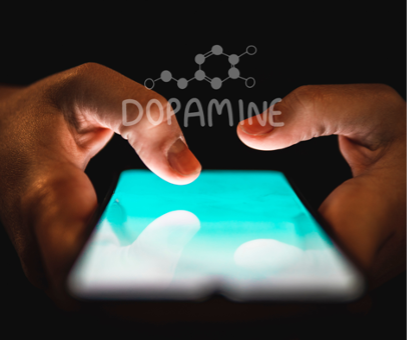
You slither into the smooth, cool protection of your bed sheets, grab your phone, and sink your head into your fluffy pillow, relieving the stress of a long workday. The bright light of your lock screen clock flashes 12:00 a.m., illuminating your baggy eyes. You punch in your four-digit passcode and set your morning alarm for 7:00 a.m.
As your eyes droop with the anticipation of a restful seven-hour sleep, you can’t help but check the red bubble on the corner of your TikTok icon, notifying you of an unread message: a video from a friend featuring a cat with sunglasses surfing on an inflatable turtle-shell pool floaty. You continue to scroll through an endless list of related pet videos, gender reveals gone wrong, and 20-step recipes you say you’ll try but never do. You check the time on the edge of your phone: 12:45 a.m. If you put your phone away now, you can have just over six hours of sleep.
“I can watch a few more videos,” you bargain with yourself. “Then I will have an even six hours to sleep.
You continue to scroll through the slew of failed marriage proposals, viral TikTok dances, ridiculous pranks, and forced street interviews with strangers. Swipe after swipe, your eyes grow heavier. You check the corner of your phone again: 1:50 a.m.
“Another hour passed already?” you think to yourself. “If I put my phone away now, I can have just over five hours of sleep…”
The infinite scroll
It is easy for many of us to get trapped in the social media scrolling abyss. Video after video, post after post, many social media users find themselves stuck in an ongoing loop of mindless scrolling, suffering with the inability to simply tap out of their apps and tune in with reality. But it really may not be all that simple. Some may attribute this helplessness to procrastination, laziness, or a lack of self-regulation skills. But our inability to stop the mindless scroll may not be completely our fault. It may offer insight into a new type of programming of our brains.
In 2006, inventor, interface designer, and co-founder of the Center for Humane Technology, Aza Raskin, developed the concept of a technology software that could allow for new pages to automatically and continuously appear when surfing the web without the page needing to load or refresh. In 2008, front-end developer and Google Chrome team worker, Paul Irish, developed this idea into a JavaScript plugin known as the “Infinite Scroll.” The use of this plugin allowed for an endless scrolling feature that permits users to surf the web without stopping. Now, the Infinite Scroll is the most used plugin for websites and apps, giving users access to a continuous stream of content accessible at their fingertips. This revolutionary plugin has provided internet users with the convenience of quick and constant phone swiping. But researchers have questioned the psychological and cognitive implications that this information overload could have on the brain.
Dopamine, the brain, and intermittent reinforcing
When you go for a nice jog, eat a satisfying meal, or engage in sexual activity, your body receives a dose of the “feel good” hormone known as dopamine. Dopamine is a chemical released in the brain responsible for our feeling of pleasure. According to Sigmund Freud’s conception of the id (the most primitive component of one’s personality), humans will continuously seek out ways to experience pleasure regardless of the consequences. However, imbalances in dopamine are involved in a variety of brain disorders such as the development of addiction.[1] Therefore, the id can be a dangerous part of our personality if left unmonitored. Freud argues that the super-ego (the more ethical component of one’s personality) fights to suppress these primitive urges, and so helps to create a healthy balance between seeking pleasure and acting morally and responsibly.
The infinite scroll triggers a release of dopamine to social media users via an intermittent reward system. When gratification or pleasure is experienced in irregular intervals, users will continue to exude a certain behaviour in hopes of experiencing another reward. As examined by Martin Zack, a scientist at the Centre for Addiction and Mental Health, the infinite scroll feature encourages prolonged and sustained use of social media by “rewarding the consumer with a steady and practically limitless stream of novel experiences.”[2] Zack’s research suggests that the intermittent reward system of dopamine release experienced by drug users and disordered gambling addiction can also be applied to other behavioural addictions such as social media use.[3] Just as a gambler may have the urge to continue to pull the lever on their slot machine in hopes of spinning their next big win, so too do social media consumers swipe down on their devices in hopes of finding new rewarding stimuli on their apps.
This constant search for new, rewarding content can be likened to being stuck in a “dopamine loop” as defined by American behavioural psychologist Susan Weinschenk. Weinschenk states that “when you bring up the feed of one of your favourite apps the dopamine loop has become engaged. With every photo you scroll through, headline you read, or link you go to you are feeding the loop which just makes you want more.”[4] Our brains become programmed to continue to swipe through our apps as the addictive behaviour settles in over time through the combination of dopamine release with a conditioned physical movement such as the swipe of a finger or thumb, making it difficult for us to stop the dopamine loop on our own accord.[5]With the introduction of infinite scroll on our social media apps, we are being given an unmonitored id. There is no feature telling us to stop scrolling so we continue, hoping to hit the next jackpot post which will provide us with a release of dopamine. We are missing a necessary super-ego, or interruptive and authoritative tool, that tells us to stop and keeps our mindless scrolling in check. These interruptive tools are called stopping cues.
Stopping cues
Prior to the introduction of social media platforms and streaming services like Netflix and Disney Plus, media consumers did not have the option to read through endless news information or binge seasons of their favourite TV shows at leisure. Newspapers and cable television programs would reach an ending point and consumers would have no choice but to put the paper down, turn off the television, and move on to another activity or wait until the following week for their next episode to air. As much as we may have hated the inconvenience of waiting to find out what shenanigans Joey and Chandler would get into on the next episode of Friends, or who would be voted off the island next on Survivor, these stopping cues were necessary in forcing us to disconnect from our pleasure centers and reconnect with our priorities.
Stopping cues are necessary interrupters that prompt us to take breaks. Without these stopping cues, many of us lack the self-control and self-regulation to prevent our binge-like behaviours. But why would social media sites want to include stopping cues on their sites when their main goal is to increase and sustain user interaction on their platforms?
From a business standpoint, these apps benefit from our addictive behaviours and inability to pull ourselves away from their content. However, maybe they need to take note from some Western European workplaces which are introducing forced stopping cues to help employees maintain a healthy work-life balance. In one Dutch design firm in Amsterdam, the company has altered the office space’s desks and tables to automatically rise to the ceiling at the end of the workday, so employees are forced to stop working.
Of course, actions like these may seem questionable; wouldn’t a company benefit from its employees staying later and getting more work done off the clock if they choose to? However, maybe there needs to be a shift of focus and priorities for the sake of our mental health. If social media apps will not provide stopping cues to help fight these addictive rabbit holes we tend to scroll down, then it might be our responsibility to re-hack our brains by introducing healthy boundaries with social media use, create our own stopping cues such as the use of timers, putting our phones on “do not disturb,” or even, taking the plunge and deleting social media entirely, thus slaying the Jabberwocky from the source.
[1] Franco, Rafael, Irene Reyes-Resina, and Gemma Navarro. “Dopamine in Health and Disease: Much More Than a Neurotransmitter.” Biomedicines 9, no. 2 (2021): 109–.
[2] Clark, Luke, and Martin Zack. “Engineered Highs: Reward Variability and Frequency as Potential Prerequisites of Behavioural Addiction.” Addictive behaviors 140 (2023): 107626–.
[3] Clark, Luke, and Martin Zack. “Engineered Highs: Reward Variability”
[4] Weinschenk, Susan. “The Dopamine Seeking-Reward Loop.” Psychology Today. Accessed September 3, 2023. https://www.psychologytoday.com/us/blog/brain-wise/201802/the-dopamine-seeking-reward-loop.
[5] Weinschenk, Susan. “The Dopamine Seeking-Reward Loop.”
1 thought on “Scrolling Down the Rabbit Hole”
Oh my goodness….You’ve described me to a tee
It’s oh so easy to be controlled by the cell phone.
Great article!! 🙂