
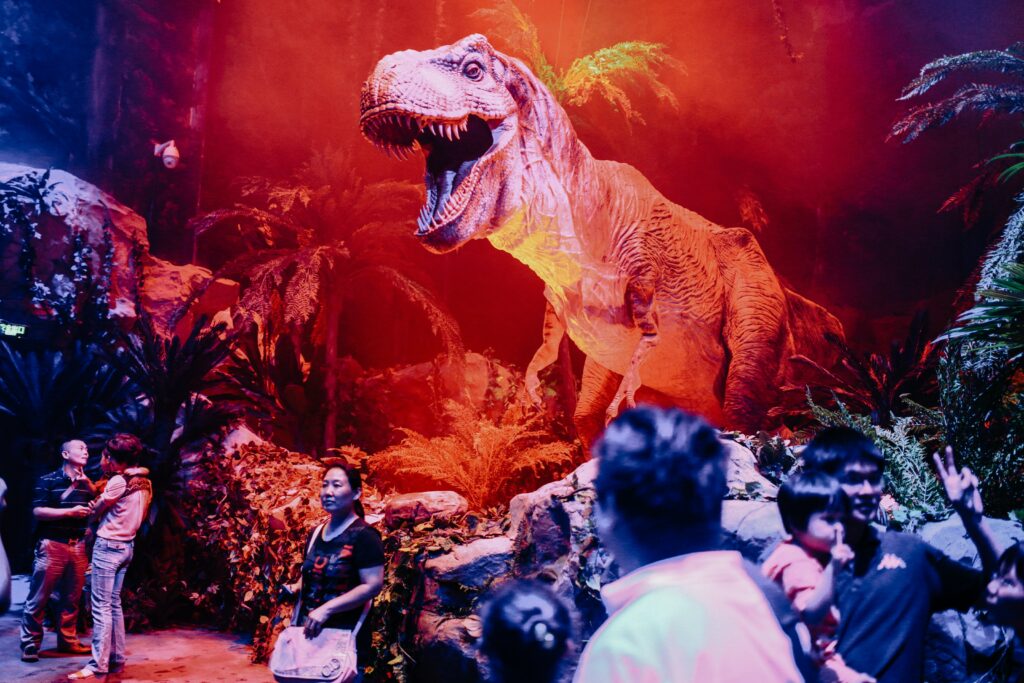
Sue the Tyrannosaurus rex (commonly known as T. rex) is an amazing discovery. She is named after her discoverer, Sue Hendrickson, an American explorer and fossil collector. Sue discovered the remains while she was excavating on the Cheyenne River Indian Reservation in 1990, near the city of Faith in north central South Dakota. The dinosaur is the most famous fossil find, and there are at least 40-60 on display in the world.
This carnivorous T. rex is 40-feet long and 13-feet high at the hip, the largest ever preserved. It was discovered weighing nine tons, with at least 90% being preserved. Sue is on permanent display at the Field Museum in Chicago, Illinois, in the Griffin Hall of Evolving Planets. Her skull is displayed separately, being almost 55-inches long and weighing 600 pounds, with her 58 teeth still intact.
The front of Sue’s skull indicated multiple holes, which were possibly related to a bacterial infection or bites from other Tyrannosaurus. But further research indicated that it was a parasitic infection named Trichomonas gallinae, a protozoan parasite that led to Sue’s demise by starvation. This parasite causes internal swelling of the neck. Sue is no ordinary find in the paleontological world of dinosaurs, and the sex is unknown.
Sue the Tyrannosaurus rex gets sold
Living during the Cretaceous period, about 67 million years ago, Sue lived to be 28 years old, as determined by the growth rings on her bones. It required six individuals 17 days for the fossil extraction. Despite being an exciting find, the discovery was wrought with a five-year custody battle that ultimately ended in a public auction in 1997 in New York, under an FBI seal, to Sotheby’s auction house.
She was purchased for $8.4 million, the largest amount ever paid for a fossil remains. During Sue’s excavation, much more was learned about the environment and what was eaten, among other interesting facts. Through studying Sue, scientists also learned more about the dinosaur’s biomechanics, movement, and intellect.
Sue the Tyrannosaurus rex gets restored
Some of Sue’s bones were decomposed, as some underwent conversion to rock from physical and chemical processes. Therefore, Sue was a rock-like copy of her fossil remains. And although some bones were missing, plastic was used by preparators to complete the exhibit. Although Sue’s soft tissues continued to decompose after her death, the rest of the body was buried by sand, silt, and mud from a nearby rushing river, which helped mix the skeleton together, so that most bones were fossilized. Most T. rex discoveries are missing over half their bones.
Our fascination carries on
Many of us have a deep fascination about the history of Earth: how it all started and where we all came from. With a deep history, our planet has shared its space with many creatures. Dinosaurs intrigue us, and so the “dinomania bug” carries on. Perhaps Steve Miller said it best: “Dinosaurs may be extinct from the face of the planet, but they are alive and well in our imaginations.”