
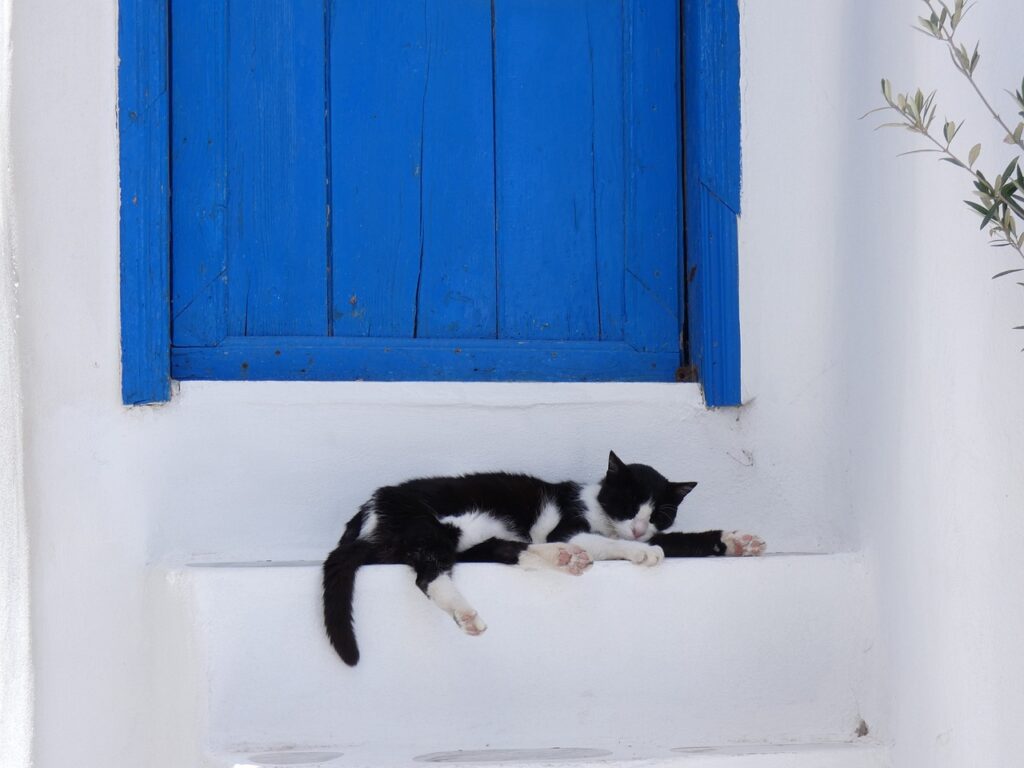
Life is complex. There’s an endless myriad of questions that keep us all awake at night. What’s the meaning of life? What is my purpose here? What’s really inside a black hole? If I were to eat myself, would I double in size or simply disappear? For those of you that have sojourned around the Greek islands, one of those enigmatic questions might be, “Why are there so many darn stray cats in Greece?”
Unfortunately, I can’t help you with any of the bigger existential dilemmas (I’m still trying to figure those out myself). I can, however, shed some light on why there are so many adorable felines wandering around Hellenic towns and villages.
Feline impressions on the Greek islands
There is a certain majesty to the Greek islands. The deep royal blue of the Aegean or Ionian Sea contrasted against arid and amber mountains. Raw and rigid olive trees scattered across the dry expanse. The smell of thyme and wild oregano in the countryside and grilled meat along the plazas and urban boulevards. And of course, colonies of stray cats almost everywhere you turn.
It’s not uncommon to watch the idyllic sunsets in Santorini, Mykonos, or Corfu with an audience of idle cats lounging lazily around you. As the Mediterranean swallows the sun, our crepuscular friends enjoy the last rays before setting out in search of a meal or perhaps a cuddle or two.

Some find it cute. Others find it puzzling. A few might be alarmed and concerned.
The worry is that these stray and feral cats are perhaps neglected and even worse, abused. Are the scores of cats around Greece forgotten and multiplying because of a lack of care? Or is there some sort of unwritten code of understanding and cooperation between cat and human?
Let’s break it down a bit.
Do Greeks love cats or do cats love Greeks? Or is it both?
My mother is from a southern coastal city in Greece. She and her family never had a domesticated cat as a pet in the traditional sense. But in her stories, she would claim they always had about half a dozen cats they called their own. They even named them. Her father—my grandfather—would routinely feed them in the morning and evening.
While they weren’t technically domesticated, my mother recalls that they would come and go as they pleased and were always welcome in the house. Mind you, my mother also grew up in the impoverished economic climate that plagued Greece in the 1960s. Their floors were earthen and devoid of any concrete or modern tiling, so any concern that street cats would invite uncleanliness was non-existent. Humble socio-economic realities is one reason cats are often welcomed in Greek homes; climate is another.

Greece enjoys roughly 300 days of sunshine a year and has a warm, mild climate. Outside large urban centres like Athens and Thessaloniki, homes are modest and minimal. Windows and doors are always open to facilitate the hospitality that Greeks take pride in and to maintain a current of cool air during the warmer months.
Cats provide the security needed to keep pests like mice and snakes out of homes, restaurants, and cafes. In response to that essential service, stray and feral cats around Greece are cared for by the community. Where you see large congregations of cats, is most likely where they carry out their unofficial security duties and where they’re fed by benevolent locals and tourists alike.
There is a mutual understanding and symbiosis. Cats take care of the mice and snakes. Humans take care of the cats. It also helps that the cats are very cute and, for the most part, friendly. Although, even with this unspoken agreement, the presence and governance of so many cats can be a cause for worry, particularly where animal welfare is concerned.
It’s not all kitties and sunshine
While Greeks—and the millions of tourists that visit the country—help to keep stray and feral cats nourished, these felines are essentially wild and unaccounted for. Without any natural predators in the urban centres they call their home, or standardized neutering practices, population sizes can become overwhelming.
Greece has one of the largest stray feline and canine populations in the world. Estimates place 2 million stray cats and dogs in Athens alone. The tragic consequence with inflated and uncontrolled stray populations is animal cruelty. There are penalties of up to €50,000 for any cases of animal torture and abuse, yet rural Greece still routinely sees cases of terrible cruelty that has been unaffected by the threat of stricter legal recourse.
As a result, Greece has made concentrated efforts to introduce sterilization protocols to curb the proliferation of stray animals, particularly cats. New laws have introduced mandatory neutering practices to prevent an increase in strays. There are also much more severe punishments for cases of animal abuse regardless of ownership.
As is the case with any aspiring and positive piece of legislation, the focus tends to revolve around intent and not implementation. Critics argue that the legislation doesn’t specify accurately enough who will shoulder the responsibility of enforcing these laws. From the other side of the room, breeders are claiming this is an attack on their livelihoods and could end the existence of cat breeds unique to Greece that have been around since antiquity.
Internationally, these new measures for animal wellness are applauded by private groups like the Greek Cat Welfare Society. The idea isn’t to rob Greece and the Greek Islands of their furry inhabitants. It is simply to ensure that they have a humane life with dignity.
What should you do when coming across stray cats in Greece?
When stumbling upon a party of stray Greek cats, what you do is really up to you. By locals, stray and feral cats are appreciated, respected, and fed for the most part. They rely on both locals and tourists for their meals and even for a little affection.
So, the next time you’re watching the Mediterranean swallow the sun and a cat is willing to come close, if you feel so inclined, give it a pet and a little snack if you have one handy. The cat and the local Greeks with mouse-less and snake-less homes and businesses will thank you.