
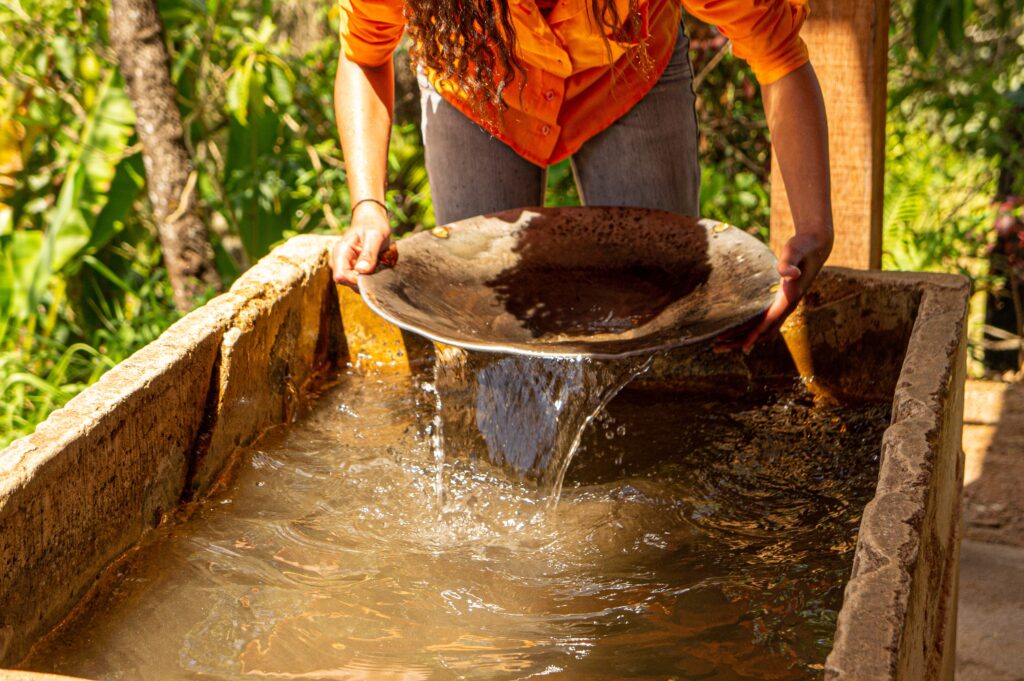
Nova Scotia’s Gold River in the province’s Lunenburg County was once inundated with gold prospectors, all seeking the coveted “colour in the pan.”
This lengthy serpentine river has its source at Gold River Lake in Nova Scotia’s valley region to the north, feeding on several other lakes before emptying into the south at Mahone Bay in Chester Basin. Originally named Gould River after an early settler, the River was renamed to Gold River prior to gold findings being discovered.
The History of Nova Scotia’s Gold River – the 1800s
In 1861, two prospectors, Daniel Dimock and David Whitford became the first to discover gold in quartz rock along the River, initiating a trek of prospectors from across Canada and the United States. The discovery area was divided into blocks of 250 feet by 150 feet, and those holding prospecting licenses laid their claims. Roads were built to accommodate both men and machinery.
Yet, the discovery of gold was probable long before 1861. In the 1840s, a captain of the Royal Welsh Fusiliers, Wales’s oldest infantry regiment, reportedly panned along the Gold River. Earlier still, in the 1830s, road workers claimed that they had found “bright yellow metal in the stone.” Not realizing what they had discovered, they literally whittled away the gold from the stone with their knives as a pastime during their breaks.
Most of the prospectors that laid claims had no real knowledge of what to look for, nor any concept of mining itself. For this reason, initial claims were abandoned, only to be undertaken by mining companies.
The History of Nova Scotia’s Gold River – the 1900s
In the early 1920s, a man by the name of Newton Meyer from Granby, Quebec, came to Chester Basin to reopen one of the mines known as the Lacey Gold mine. Rumour has it that a prospector known as John Lacey, who lived in the area, had been working one of the shafts and found the mother lode. In his excitement, he raced home to tell his wife of his finding but died from a heart attack on route. Unfortunately, his discovery died with him on that fateful day.
The Lacey mine was eventually taken over by the Nova Scotia government in 1936. Once again, in 1939 the project was abandoned with the outbreak of World War II.

The Gold… where does it come from?
The last ice age began about 100,000 years ago, lasting until 25,000 years ago. It played an important role in gold distribution. Huge glaciers progressed toward the Atlantic Ocean creating the existing landscape of Nova Scotia and exposing some gold-bearing veins that prospectors did find. Yet, many veins were buried under sheets of thick boulders, sand, and clay. The initial attempts of reaching these veins were somewhat unwieldy and wasteful.
The yield of gold from crushed ore greatly depended on the visibility of the gold. In the past, once quartz ore was brought to the surface, only fragments with visible gold were sent to the crushers. This meant that large amounts of gold were sent to the crushers, resulting in large quantities of gold being sent to dross or refuse piles. Much of the fine gold was lost to crushing and processing methods. Years later, tributors – those who worked the ore for a set monetary amount – were well rewarded with their crystallized gold discoveries in the refuse.
Gold panning in today’s world
Gold River witnessed many prospectors along her shores in the past, some that left encouraged and others disappointed. It is not over yet for the gold seeking enthusiasts. Today, there are still panners in the area who are determined to find their weight in gold.
To the experienced panner, gold is not difficult to recognize. It usually materializes in small flakes rather than large nuggets, as old prospectors or movies might suggest. It is often associated with pyrite or “fool’s gold”, distinguishable in a few ways. Pure gold will flatten when hammered and is quite heavy, which makes it ideal for panning since gravity separation will leave the gold fragments in the pan.
Gold accumulates in placer deposits (alluvial) along a beach or in river sediment as a consequence of the erosion of gold-bearing rocks. A suggestion for panning in Gold River is to locate old mines with the help of the Nova Scotia Prospectors Association (NSPA) which works closely with the Department of Natural Resources.
These mines have piles of tailings, or waste rock, which often contain gold fragments. Another suggestion is to look on the downstream side of boulders as suspended gold can slip into the slow moving water and collect as placer deposits.