
We humans may have to rethink how we perceive intelligence. Although primates have long been utilized as research to gauge animal intelligence, researchers have long known that turning their attention beneath the seas may provide a better insight of just how intelligent some creatures are.
Science has proven that some marine mammals (cetaceans), such as whales, have cognitive abilities that may possibly surpass our own. They are known to communicate, possess self-awareness and are highly emotional creatures.
Perhaps, this is our fascination with whales, the biggest creatures that ever lived and have been with us for millions of years. Or maybe, it is just the fact that they are such wondrous creatures to observe in their natural habitat.
Species of Whale
In the Atlantic Ocean are found Minke, Finback, Humpback and Blue Whales with the Minke and Finbacks being the most observed. The best time to view the intriguing whale is throughout the spring and fall when feeding grounds of krill are plentiful; their main food source.
Species of whale can be hard to identify, unless you are an expert. Yet, there are some distinguishing characteristics, such as having a dorsal fin, body length, general body shape, swimming patterns and shape of the blowhole (spiracle) the means by which whales breathe. Minkes and Finbacks share a lot of similarities. Minkes have a very distinct white patch on the top of their pectoral fin, whereas the Blue whale has an oddly shaped dorsal fin and Humpbacks have a distinctive bushy blowhole.

The Blue Whale
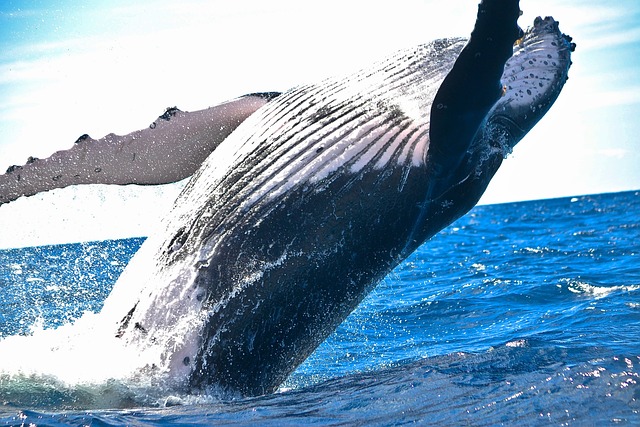
Of all the whale species the Blue whale (Balaenoptera musculus) is the largest which can grow from 69 to 100 feet long and can weigh as much as 440,000 pounds, with their tongue alone weighing as much as that of an elephant. They can be very inquisitive creatures, often interacting with boaters who are intrigued when a whale breaches (jumps out of the water) to get a better look at its audience. But at all times, it is important to respect a whale’s space – at least 50 meters or more away.
Whale Watching Tips
If a whale decides to approach a boat, that’s a real privilege. When viewing a pod of whales, you should be able to discern which way they are heading. Steer ahead of them and stop the boat. It is not advised to try to chase them as you are not supposed to.
Dress Warm
Like all engaged water activities, it is essential to be prepared while whale watching. The most important thing is dressing warmly. It may be warm and humid on land, but sea temperatures can be considerably cooler, sometimes by as much as 20 degrees or more. Sea spray from a moving boat will quickly dampen any enthusiasm while on board and could chill to the bone. Packing a warm blanket is always good advice.
Bring Binoculars
And don’t forget the binoculars, a camera, rubber boots, sunscreen and sunglasses. For those prone to sea sickness, take medication before your adventure and also bring it along with you. Seas can be rough on seemingly calm days. Also, snacks and drinks are always a good idea. Eating regularly will help prevent sea sickness as well.
Be Patient
Lastly, pack a lot of patience. Keep in mind that whales are wild mammals and are constantly on the move. If a whale surfaces at any time, it is unlikely to return to the same locale. Constantly scan the waters for any whale activity.
Whale watching is such an exhilarating experience when given the chance to observe these wondrous mammals in their natural habitat. Respect their space and try to remain an unobtrusive audience at all times.