
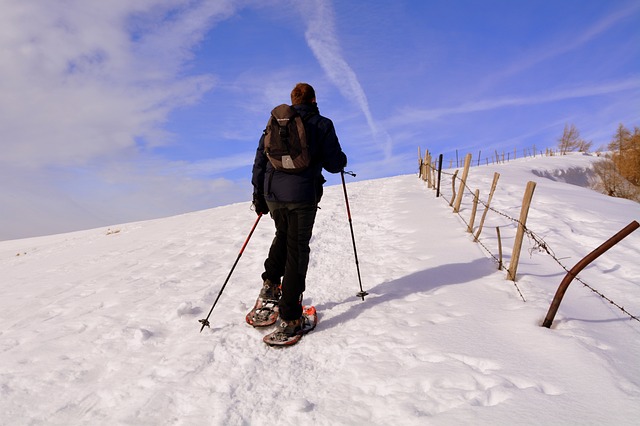
With the holiday festivities now a past memory, some may have fallen victim to a dreaded holiday aftermath – an expand ….ed waistline. Forget the gym membership unless of course that is your preference.
Why not try a simplistic approach to weight loss and have some fun partaking in its rewards in the great outdoors? Consider the snowshoe hare. It is called a ‘snowshoe’ for a reason. Its generously furred hind feet and four long toes on each foot are widely spread to enable even weight distribution, thus the ability to leap and bound even in the softest, deepest snow. For the snowshoe hare this adaptation is natural.
For us, we have to improvise, thus one of the oldest inventions of humankind – the snowshoe. It is believed that the first snowshoes originated in Central Asia.
Today’s light weight designed snowshoes make snowshoeing an increasing popular winter activity. Snowshoeing is an excellent source of exercise and a great reprieve from the winter doldrums. It can be enjoyed by people of all ages who are in good health. If you can walk, you can snowshoe, and it doesn’t require a large investment and affords the maneuverability to trek where cross-country skiers and snowmobilers cannot.
Snowshoeing offers an unhindered adventure into a snow-covered landscape with serenity and the wilderness as your reward, enjoyed as a casual hike with friends, or an overnight backpack venture, the pace of which is at your discretion.
So how do you get started in your snowshoeing adventure? First, it has to be determined how you plan to use your snowshoes. Will they be used for walking or backcountry hiking on steep, closed-in trails or open groomed trails? Do you require recreational snowshoes used by beginners for gentle, accommodating terrain, which are easily adjusted and have moderate traction?
Or adventure snowshoes used by the most experienced for tougher terrain which provides better traction in icy conditions? Perhaps backcountry snowshoes used for harsh conditions and terrain, trail breaking, or steep ascents would suit you fine. The decision is yours.

Selecting the correct snowshoe size is dependent on body weight and any additional weight such as carrying a child. This is referred to as carrying capacity or recommended load, usually based on light, dry snow conditions.
A heavier individual requires snowshoes with a larger surface area to distribute their body weight evenly. Some snowshoes are designed specifically for women, children or running.
Terrain is another consideration. Brush, forest or packed trails require compact shoes which are easily maneuvered in tight spaces. They are also better adapted to steep or icy terrain, whereas open terrain with deep snow drifts require larger snowshoes. It is best to select a smaller size that supports body weight and is suitable to the snow conditions and terrain in your area.
The average person will burn 375-950 calories per hour snowshoeing, perhaps more if you run or climb, since snow provides great resistance.
Aside from strengthening your quadriceps, snowshoeing builds endurance. When poles are used, your arms, shoulder and back muscles get a complete workout in a relatively safe sport, but like any other sport, it requires some common sense and forethought. Always let someone know where you are going and for how long. Check your snowshoe bindings and poles for cracks, and make sure you have these essential gear items:
- Map
- Compass
- Duct tape (for emergency repairs on snowshoes or poles)
- Lots of water to avoid dehydration
- Appropriate clothing
- Physician’s approval
When you are out on your adventures, be wary of thin ice; avoid frozen lakes and streams unless you are sure of their safety. Beware of barbed wire fences and holes and uneven terrain under the snow. Respect any wildlife you may come across; keep your distance and know that you are in their environment. Protect all exposed appendages from frostbite. Temperatures can drop quickly especially with windy conditions.
Snowshoeing, along with other winter activities, can be a great adventure. Get out and enjoy your snowshoes. With climate change our new reality, let’s appreciate the snow while we still can.